


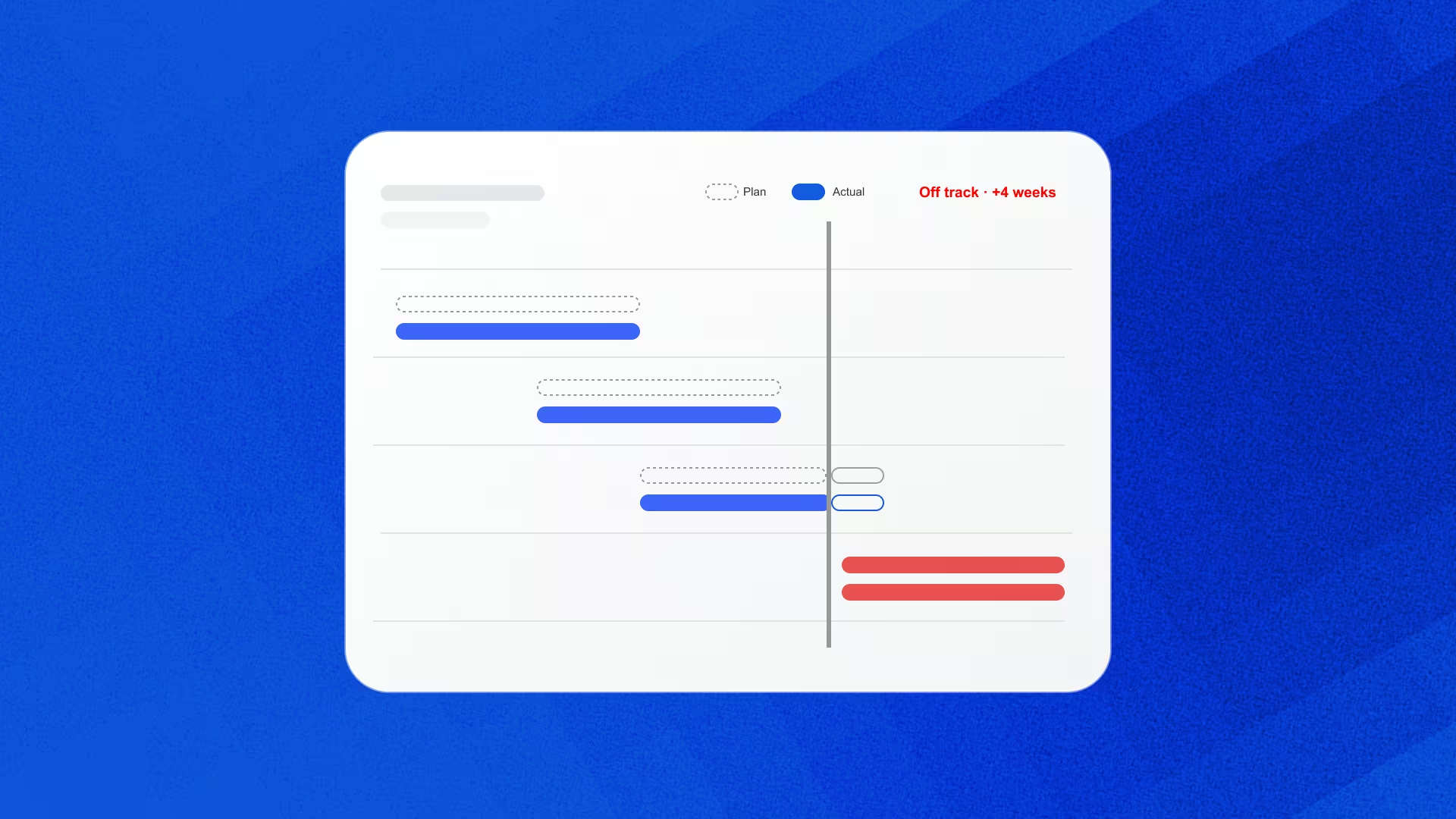
The Federal Reserve’s renovation budget grew by more than $1 billion. Then the inspector general undertook an investigation to assess what happened.
After reading this report, I had an immediate reaction:
Why does explaining a project’s cost history require reconstructing it after the fact?
My takeaway is that the failures described here expose a structural problem in how construction costs are managed across organizations. The industry produces estimates, bids, spreadsheets, and reports without an underlying system connecting them into a cost record everyone can interrogate.
It's a problem I've spent years thinking about (and solving for with Ediphi…) and the Fed's most recent report is one of the clearest illustrations of it I've seen.
Multiple perspectives without a shared cost framework
The report documents a budget increase from $1.317 billion to $2.381 billion.
Inflation, design changes, challenging site conditions, and weaknesses in cost management are all identified as significant factors. It also describes dashboards that continued to report the project as “on track” as budget and schedule benchmarks changed.
There were multiple perspectives available to challenge this budget. (Behind the general contractor, Balfour Beatty–Gilbane joint venture, the team had A/E and independent consultant estimates.)
The question is whether those perspectives were structurally connected.
When each organization works in a different estimating solution, Excel often becomes the common data environment. Everyone exports a file, then someone tries to match the rows, reconcile the scope, and explain the differences.
For an estimate containing thousands of line items, this becomes extraordinarily difficult. Each individual party can use different classifications, units, assumptions, document revisions, and levels of detail. Two rows with similar names may represent different work and two different totals may reflect different project definitions.
Putting those files in the same folder does not make the underlying estimates comparable.
The project needs one cost ontology
When we say “cost ontology”, we’re referring to the whole structure that defines what is being priced and how the parts relate together.
Practically, this looks like every stakeholder working from one agreed definition of the project: the documents and revisions, program, areas, use groups, systems, scope, quantities, units, and cost metrics.
On the Fed project, at least four parties had a view on cost: the A/E firm, the third-party independent estimator, the construction manager, and the owner's representative. Each perspective is uniquely useful and their pricing opinions should remain independent, but priced using that same cost ontology.
For that to work across organizations, the tools everyone uses need to support:
- One project definition. Every estimate is built on the same documents, revisions, areas, and systems.
- Common classification. Every line item maps to the same breakdown, such as UniFormat or MasterFormat.
- Traceable quantities. Each takeoff quantity links back to the drawing and revision it came from.
- Independent budgets. Each party prices the work on its own without overwriting anyone else's.
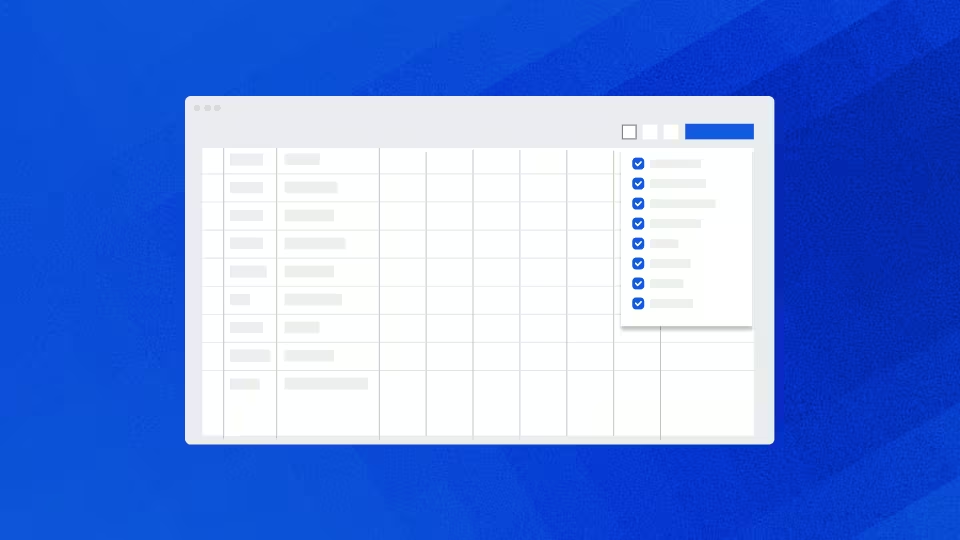
- Line-item variance reporting. Differences between estimates can be compared line by line and explained.
- Version history. Every revision is saved, so changes between versions stay visible.
With that in place, a difference in HVAC pricing between the A/E and the construction manager could be traced to the cause. A program change, like the Board's 2023 switch from mostly open workspaces to mostly closed offices, could be connected to the scope and quantities it affected.
At the end, the owner gets a continuing cost history rather than a succession of disconnected totals.
A design budget needs construction pricing behind it
To go back to the specifics of the report, the Board built its budget on a detailed, 149-page estimate from its A/E firm, along with a second estimate from an independent estimator.
The project team didn't ask the construction manager for cost estimates because it already had those two. The construction manager's first project-level estimate arrived in January 2026, three and a half years after construction started.
Both estimates were informed opinions about cost, but neither came from the party that would actually buy out and build the work, and neither was tested against what subcontractors would bid until the bids came in.
The MEP packages show what happens when that test comes late.
Four packages were estimated at $206 million in 2022 and awarded at $694 million. Three of the four received fewer than three bids, and the Board didn't ask its owner's rep to independently check the pricing before awarding them.
That gap needs an explanation. It does not, by itself, establish that the contractor overspent. It could also mean:
- The original estimate was wrong
- The scope or quantities changed
- Or limited competition and market conditions pushed pricing up
Each of those has different implications for the owner, and when the bids arrived, there was no structured way to tell which one applied.
That is the kind of question a shared cost framework is built to answer, and it's the reason we built Ediphi the way we did.
Why every project owner should use Ediphi
The Fed's renovation is an extreme example, of course, but this is a pattern that shows up on projects of every size. The owner funds the project and bears the consequences of its decisions, and it is often the party with the least direct view of the cost record.
This is why I believe every owner should require its project stakeholders to work within a shared cost framework and why we’re building that structure in Ediphi.
Connecting cost information across estimating, benchmarking, bid leveling, and buyout makes it actually possible to manage the project as one continuous financial story.
A billion-dollar project should be able to explain its own budget.
Owners should make this a requirement from the beginning: a common project definition, comparable stakeholder budgets, line-item variance analysis, and a continuing record of cost decisions in Ediphi. The cost story should be available when a decision is being made, while the owner still has options.

.svg)





.svg)
.svg)