AI can suggest alternates or flag scope gaps, but it’s your estimators that will be the ones defending the number at the GMP review. And they can only do that if they know what data the AI worked from and can trace it back in the system.
Few construction softwares are set up for that.
In The Estimator's Guide to Cloud-Based Software, we made the case that "cloud" had stopped meaning much. Nearly every vendor claims it, and the word usually describes where software is hosted, but it rarely describes how the software is built.
We narrowed it down to four requirements:
- It's built for the web
- Everyone works in one shared system
- Calculations run on the platform's servers
- All project data lives in one structured database
We ended that guide with a claim: those four requirements are the ground AI has to stand on. This piece is about what gets built on that ground.
The next wave of AI in preconstruction analyzes your data, reads your live estimates against your project history, checks, compares, and flags, and brings what it finds to your team at a scale no estimating team has ever worked at.
That's agentic preconstruction, and it changes what you should ask a vendor before you sign.
Below, we cover:
- What agentic preconstruction is, and why it depends on cloud-based software
- Seven questions to ask any vendor, in the order the problems show up
- What to listen for in the answers
What is agentic preconstruction?
Agentic preconstruction is AI that takes on work inside your company's own cost data. It's given a goal, works through your live estimates and project history to reach it, and brings its findings and recommended changes to a person for review.
Ultimately, AI is heading towards:
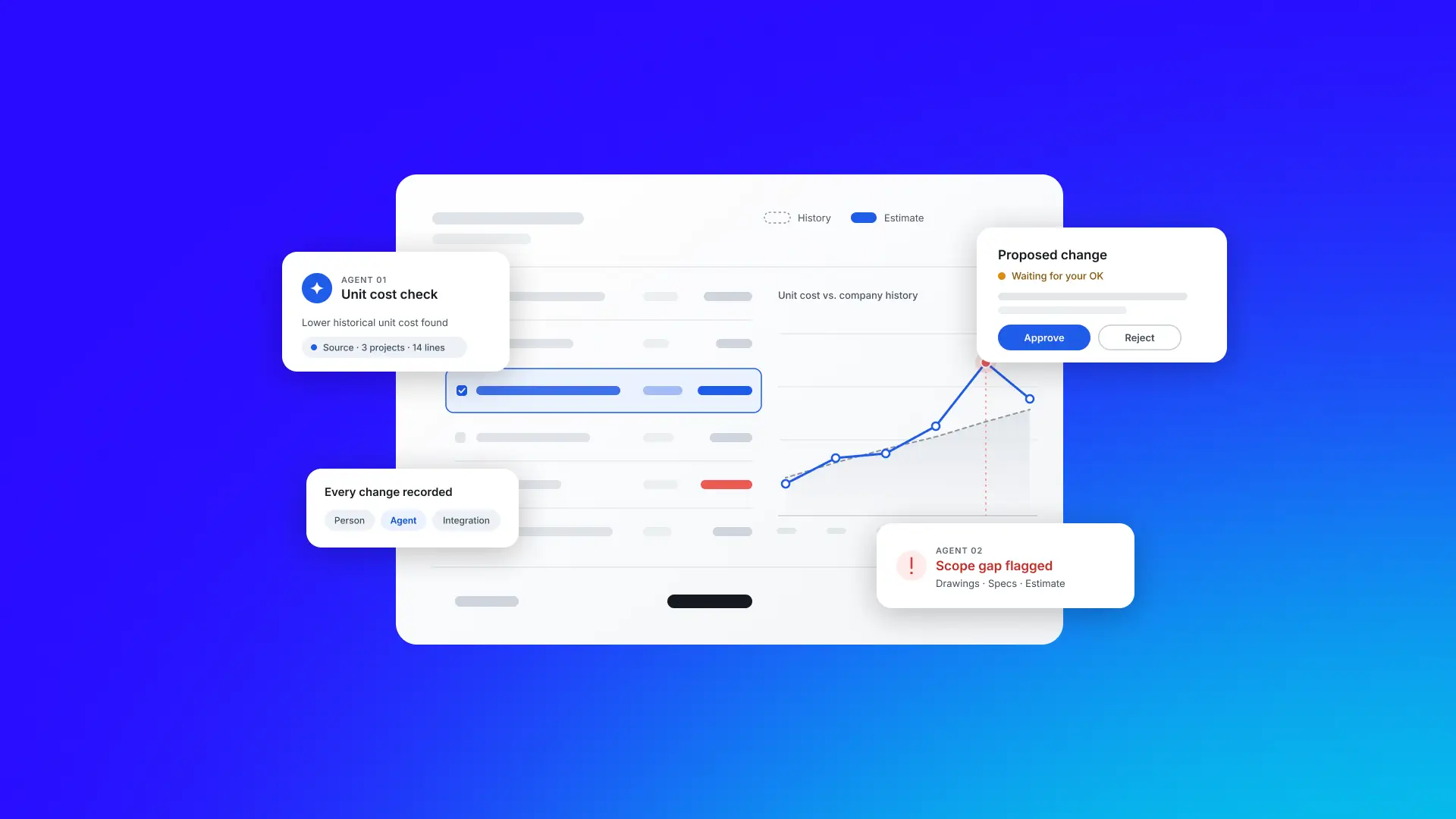
- Checking unit costs against your company's history
- Flagging scope gaps between the drawings, the specs, and the estimate
- Comparing alternates and value management options
- Testing what happens to the number when the owner changes the program for the third time this week
- Pulling in changes from takeoff, scheduling, procurement, and accounting, and show what they mean for cost
This is all good news for precon.
There are never enough estimators, and the ones we have spend too much of their week on setup, data entry, and re-keying. AI that analyzes your data takes that work and leaves estimators the part only they can do: judgment.
Three things that make AI a new kind of user
Every estimating platform was designed around a person at a screen. AI analyzing your data changes that in three ways.
- It doesn't need a screen. AI analyzes best when it can query the platform's data directly. When it can't, it has to imitate a person clicking through screens to read the numbers.
- It runs at volume. First a few agents, then dozens, then hundreds, all analyzing the same estimates at once, around the clock.
- Its findings need sign-off. AI recommends, but a person has to see the evidence, check the reasoning, and approve the change.
Where the cloud comes in
AI analyzing your data needs everything your estimators need from the platform, at a volume no team of estimators has ever produced.
That's why the four requirements from the cloud guide come back here. In that guide, we tied each one to something AI needs to analyze your data well:
For a more comprehensive look at the requirements of cloud-based software, read the guide here.
Agentic preconstruction adds a fifth: governance. Once software is analyzing the estimate and recommending changes, people need a way to review it, approve it, and prove later what happened.
Cloud is a hosting decision. Authority is an architectural decision.
A platform that clears all four requirements gives AI clean, current data to analyze. Governance decides whether the company can trust what they produce.
7 questions to ask before AI analyzes your estimates
The seven questions below ask about the architecture underneath. Features change every release. Architecture decides what AI can do with your data for the next decade.
They fall into three groups.
- Can AI do the work? How agents get into the platform, and what happens when there are hundreds of them.
- Can the platform keep one version of the truth? Where the math runs, how disagreements get settled, and what happens when data crosses between systems.
- Can people govern it and prove it? What the people supervising the work can see, and whether any number can be reproduced later.
1. How will an AI agent perform work inside your application?
Ask: What does "deploying an agent" into your product actually mean? Does it take control of a machine or VM and click through the interface like a person? Does each agent need its own installation, configuration, and license? If the product is browser-based, does the agent call the platform directly, or does it still drive a browser like a human would?
Why: The answer shows whether the platform was built for machine access or is automating a human interface, and only one of those can be governed. An enterprise platform should give authorized agents controlled ways to perform specific operations, without pretending to be people sitting at computers.
Look out for: A vendor who describes the agent as "operating" the software. Cost and complexity that grow with every agent you add (a VM, an install, a license each). Vague answers about what happens when the interface throws an error the agent can't resolve on its own.
2. What happens when multiple agents are working simultaneously?
Ask: When multiple agents touch the same estimate at once, which change wins? Can one agent overwrite another's work, or a person unknowingly overwrite both? Does the platform understand these as related activities, or does it just see multiple file versions? How are conflicts detected, shown, and resolved?
Why: Desktop applications were built around one person in one session. The future is hundreds or thousands of agents reviewing, updating, and testing against the same estimates at once, a workload the original design never anticipated. The platform has to coordinate that work.
Look out for: "Every agent gets its own desktop or VM." That keeps agents apart, and nothing is coordinating them.
3. Where do formula-driven calculations execute?
Ask: Could two agents start from the same number and finish with different ones? Could one calculation overwrite another without anyone noticing? Can the system explain exactly why a number changed?
Why: Costs in estimating are derived. They're chained through quantity, rate, crew, material price, escalation, waste factor, location, and markups. When multiple people (or agents) change different inputs at once, each change triggers its own set of dependent recalculations. The result is only trustworthy if the platform knows which state those calculations actually ran against.
Look out for: A vendor who answers with recalculation speed ("it updates instantly") without addressing ordering. Fast and certain are two separate claims. If the system can't reconstruct why a number changed, it can produce more numbers without producing more truth.
4. How will agents reconcile conflicting recommendations?
Ask: Can the platform preserve each competing recommendation without corrupting the working estimate? Can it show the evidence behind each one? Can a person approve one and reject another, and does the system keep that decision and the reasoning behind it?
Why: Agents won't always agree. One may flag a lower historical unit cost, another an unusual schedule, a third a different system based on current market conditions. Without a way to hold those recommendations apart, the company never really chooses between them. It keeps whichever one happened to write to the estimate last.
Look out for: Any agent that writes directly into the live estimate. Every change should arrive as a proposal someone can review. Anything else is an uncontrolled editing problem, whatever the vendor calls it.
5. How will an agent in one system work with an agent in another?
Ask: Do the platforms exchange structured information through governed services and defined contracts, or does information still move through files and manual imports? When one system changes a quantity, schedule, or cost, how does the receiving system know what changed? Is there a shared record of that transaction?
Why: A preconstruction agent doesn't work alone and it needs to interact with agents (and people) in scheduling, design, procurement, accounting, project management, quantity takeoff, and, well, everything…
The future of enterprise software is systems and agents coordinating work across organizational boundaries, well beyond a single app with its own AI assistant.
Look out for: An "integration" that turns out to mean exported spreadsheets, watched folders, or one agent driving another system's interface like a person would. If the answer amounts to a chatbot bolted onto a legacy application, you're looking at two isolated tools passing notes.
6. What becomes of the user interface when agents perform more of the work?
Ask: If an agent creates an estimate, does a person still need to click through every screen originally designed to do those tasks by hand? Or does the interface evolve to help people make decisions? Can it show:
- What changed and why
- Which assumptions were used
- What the agent recommends
- What requires human judgment
- What other systems or agents were involved
Why: Most construction applications are designed around the assumption that a person will manually navigate every workflow. That assumption stops holding once agents do the creating, evaluating, and updating.
Look out for: A platform designed entirely around human data entry, where the workflows, business logic, and interface are inseparable. It will struggle to make this transition.
7. Can the system reproduce every result?
Ask: Can the vendor reproduce a number using the exact data, formulas, and permissions that existed when it was created? Can it identify whether the result was produced by a person, an agent, an integration, or some combination of the three? Can it explain every change between two versions?
Why: This may be the most important question of all. Everything else about agents, concurrency, and calculation only matters if the platform can actually stand behind the number it produced.
Look out for: An answer that depends on finding the correct file, opening it with the correct application version, locating a spreadsheet, or asking the estimator who created it. That company doesn't have an authoritative enterprise system.
AI does not fix fragmented architecture
AI is only as reliable as the data it's analyzing.
(If the underlying estimate lives across disconnected files and independent desktop sessions, AI only adds one more party claiming to know the answer.)
For AI to analyze your data meaningfully, it needs the same structured, governed, reproducible information a human estimator relies on: the same quantities, rates, assemblies, scope, and business rules, and a clear record of what's current and what's been superseded. It has to call the same authoritative logic the platform already uses for everyone else.
The next system of record for construction
Modern preconstruction is collaborative and continuous.
Pricing develops from the earliest conceptual model through detailed estimating, value engineering, procurement, buyout, and ultimately the actual cost of construction.
All of this information becomes the company's cost intelligence. It's also exactly what AI needs to analyze, which is why architecture really, really matters.
Ediphi started with that architecture; it’s basically the opposite approach to how construction tech companies are using AI.
Before building any AI, we spent years building the system it would analyze. Ediphi is one shared web application. Every formula runs on our servers against one official estimate and every project lives in one structured database, with every line coded to a bid package, every milestone kept, and regional catalogs maintained across the portfolio. Every change is recorded, along with who made it.
That's the part of AI nobody sees, and it's the part that can't be added later.
"AI is only as good as the data you feed it, and our [industry] data is a mess." — Dustin DeVan, CEO at Ediphi
What we're building
With that foundation in place, we're now building Ediphi AI: AI that analyzes your company's own cost data, on the same authoritative record your estimators already use.
Four principles are shaping it:
- Every number shows its source. When AI gives you a figure, it will show the project, estimate, and lines behind it, so anything can be checked.
- Your data stays yours. AI works on your company's own history, inside the same permissions your team already has.
- You stay in control. AI shows its work and the source behind every number. It doesn't decide your number, and it doesn't change your estimate without your OK.
- AI goes where you work. It starts inside Ediphi and, over time, will reach you in the AI tools your team already uses.
Because it runs on the same system of record as everything else, it can show up anywhere that record does: answers from your own estimates with the source behind every number, then changes you ask for that wait for your OK, and eventually estimates that start from your plans and specs.
A modern interface may make software easier to use. A hosted environment may make it easier to deploy. An AI assistant may make an individual user more productive.
An authoritative platform gives the enterprise something much more important: a number it can trust, reproduce, govern, and continuously learn from, whether the work was performed by a person, an agent, or both.
To see the foundation of Ediphi AI, reach out to us here.