


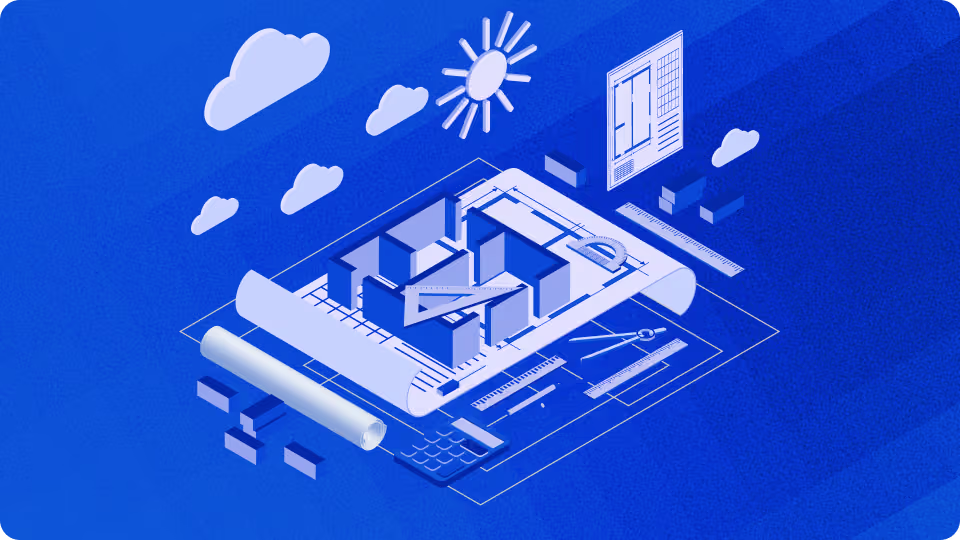
Most construction companies evaluate software based on features.
What it does. What it shows in a demo. What checks the box.
That’s the mistake.
Features don’t determine whether software will work for you long-term.
Architecture does.
You Would Never Ignore the Foundation
In construction, no one evaluates a building based on finishes alone.
You look at:
- The foundation
- The structure
- The systems behind the walls
Because you know those are the things that determine whether the building lasts.
- Can it handle change?
- Will it hold up over time?
- What happens when requirements evolve?
But when it comes to software, most RFPs ignore the equivalent entirely.
They evaluate what the software does today—not how it’s built, or whether it can keep up with how your business will operate tomorrow.
The Desktop Tool Trap
A lot of “modern” construction software is still built on old assumptions.
- Desktop-first workflows
- Rigid data structures
- Systems designed for control instead of flexibility
Some of these tools have been moved to the cloud. Some have better interfaces.
But underneath, the architecture hasn’t changed.
And that creates a ceiling.
You feel it when:
- Simple changes take months
- New workflows require workarounds
- Integrations are fragile or impossible
- Your team adapts to the software instead of the other way around
This isn’t a product issue.
It’s an architecture issue.
Why Big Software Companies Can’t Keep Up
Here’s the part most people don’t say out loud:
Many of the largest construction software companies are structurally limited in how fast they can innovate.
Not because they don’t want to—but because of how they’re built.
They’re dealing with:
- Legacy codebases that are hard to change
- Large customer bases that resist disruption
- Product decisions made by committees
- Release cycles measured in quarters—or years
Every change carries risk.
So they move carefully.
And over time, that caution turns into stagnation.
Startups Move Differently
Startups don’t have those constraints.
They’re built on:
- Modern architectures
- Smaller, more flexible codebases
- Tight feedback loops with customers
They can:
- Ship faster
- Iterate continuously
- Adapt to new workflows in real time
That difference compounds.
What starts as a small gap becomes a massive one over a few years.
You’re Not Buying Features—You’re Buying a Trajectory
When you select software, you’re not just choosing what it does today.
You’re choosing:
- How quickly it will improve
- How easily it will adapt
- Whether it will keep up with your business—or hold it back
A system with a weak foundation doesn’t fail immediately.
It slows you down over time.
And by the time it becomes obvious, switching is expensive.
What Most RFPs Get Wrong
Most RFPs focus on the wrong things.
- Do you support this feature?
- Can you integrate with this system?
- What does it cost?
Those questions matter—but they’re not what determines long-term success.
The better questions are:
- How is your system architected to evolve?
- How quickly can you support a new workflow?
- How often do you ship meaningful improvements?
- What constraints does your current architecture create?
Because your workflows will change.
Your business will evolve.
And your software either enables that—or limits it.
Final Thought
Construction companies obsess over the long-term performance of physical assets.
But when it comes to digital infrastructure, they still buy for the demo.
The companies that win won’t be the ones who picked the most features.
They’ll be the ones who chose software built to evolve—and partners capable of keeping up.
Because in the end, features are temporary.
Architecture is what determines how far—and how fast—you can go.

.svg)




.svg)
.svg)