


The construction industry has no shortage of complexity, but few stages are as misunderstood as preconstruction.
In a recent interview with industry leader Doanh Do, co-founder, Dustin DeVan (and former founder of BuildingConnected acquired by Autodesk) talked about why estimating is still so painful, why legacy tools aren’t keeping up, and what the next five years have in store for preconstruction.
Here’s a recap of the conversation (and a link to the full interview beloiw if you’re more of a watcher than a reader).
Q: Why is estimating so painful right now? What’s broken?
A: It’s broken for a few reasons.
For the most part, venture capital has not put any money into precon. A lot of money gets put into project management software because project teams are often very quick to adopt. Unfortunately, construction folks are less likely to try applications and it’s holding them back from getting really good solutions.
[But] it's to their betterment, especially the young ones, if they start adopting more modern solutions because if they don't support the startup ecosystem, what you're going to end up being left with is the legacy providers that exist. Whether it's Excel spreadsheets or it's Trimble WinEst or it's Costex or it's Sage or it's Destini Estimator, these old legacy desktop tools, that's what's on the market today.
If we don't support [modern cloud applications], we get this old vision of the world, which is the other fundamental problem with precon.
Q: What do you see is the fundamental problem with precon?
A: We design projects we cannot afford.
I absolutely think that, instead of us designing then pricing, we should price then design. We have to completely reverse how owners go about thinking about projects. [Owners] should talk to builders who know what projects will cost in order to better understand their pricing options and design a project that will meet their budget.
This will compress pre-construction. It'll mean less value engineering and it'll be more likely that projects that go through precon actually take place and materialize.
That paradigm is something that we're trying to change with Ediphi.
Recommended reading: The Future of Preconstruction Starts with Cost, Not Design
Q: What is Ediphi trying to solve?
A: There's a few problems that exist in precon today.
Estimating right now is done on desktop tools. Which is very good if you are an estimator but if you are a team of estimators or an entire organization of estimators there's some serious drawbacks from that.
We want to bring estimating to the cloud and help estimators tell their cost story. So that's every time they tell clients what a project could cost that is part of a communication, your precon process.
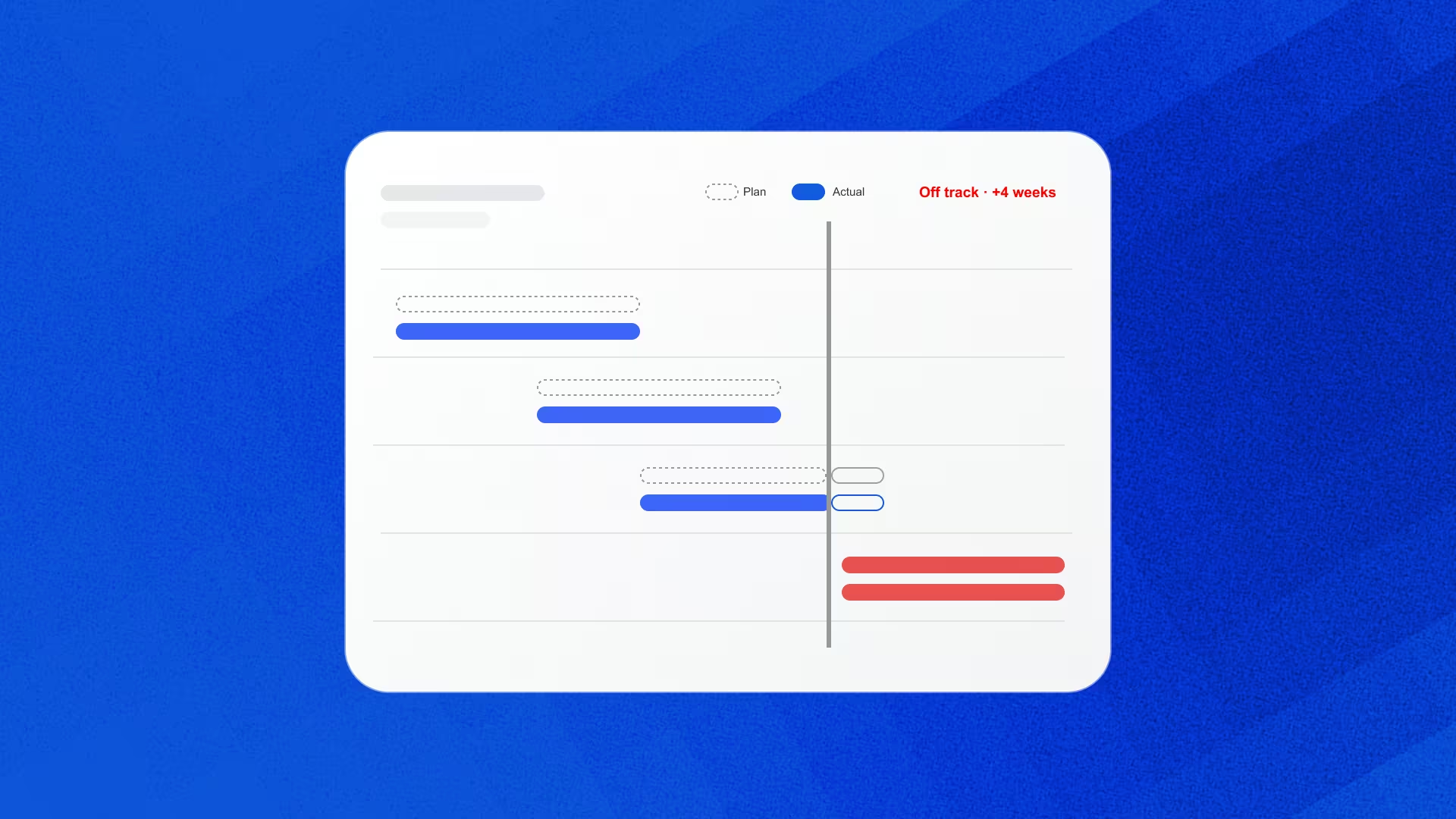
Ediphi provides a way to track what cost you submit to a client across all the design milestones of your project and talk about why things vary over time, which the industry doesn't have anywhere today.
Q: Why are you interested in preconstruction?
A: You know, I was just at Autodesk University and saw their new estimating tool — and Autodesk's vision of pre-construction is completely misaligned with how estimators work.
The Autodesk vision is that everything is design. You design it to the tea and then you price it. And, to not understand that cost dramatically affects what you do design. It’s crazy. They are engineering and architecture focused, not construction focused or economics focused. They don't have a broader vision to actually improve the industry.
It’s my position that if builders want a better precon process, they should start looking to the startup community who can actually provide them with meaningful changes. And one of those companies is Ediphi — but there's a bunch of them out there — I say test it out.
Build a process into your precon team that allows you to vet these tools. Everyone has time to tinker around.
Q: What's your vision for this space in the next 5 years? What’s going to happen?
In the next 5 years I think construction is going to realize that every project is on a spectrum.
There’s:
- Form. This is when all you care about is the aesthetics of the project. You're talking about building the Burj Khalifa in Dubai, where you don't care about money. It’s not an object.
- Then on the other side, there’s function — when all you care about is building something at the lowest cost possible.
As soon as we realize that most projects in that spectrum are centered on reaching the objectives of the function, we'll understand that we need to care about cost before we start building designs.
I would love to see precon come in and really understand the cost. Not from a cost consultant's perspective, but a data perspective.
Watch Dustin’s full keynote on how data, AI, and the cloud are transforming preconstruction.
Q: Where do people make the biggest mistakes in estimating?
A: The biggest mistake I see is that people produce low-fidelity estimates very early in the conceptual phase.
The best builders are not trying to just get plans and extract quantities. The best builders are trying to get projects handed to them as early as possible so that they can influence the design and have meaningful conversations with the clients.
I see too many conceptual estimates today that, you know, might fit the entire interior and say it's $500 per square foot. Well, what were you assuming for every individual room? That's the level of estimating that you should be able to do on every single project so that you inform the designers of your assumptions. And you can do that with Ediphi.
I encourage every estimating and precon team to try to put as much detail into the estimate to qualify your assumptions as early as possible. That way you can explain why quantities and unit costs go up or down to the client.
Where preconstruction goes from here
The next era of preconstruction won’t be shaped by legacy tools or by doing things the way they’ve always been done. It’ll be driven by teams who are willing to rethink the process — starting with how cost shapes design, how estimates evolve, and how collaboration happens in real time.
If you want to hear the rest of Dustin’s perspective on where the industry is headed, you can watch the full interview.
And if you’re curious how a modern approach actually works in practice, try Ediphi on your next estimate and see the difference for yourself.

.svg)



.svg)
.svg)